
Marketing Measurement + Attribution
If you cannot draw a line from spend to closed revenue, you are guessing.
Most dashboards report clicks, impressions and a conversion count the platform calculated itself. None of that tells you what actually closed. We build the plumbing that connects every dollar you spend to the revenue your CRM says you actually collected, so your next budget decision is based on a number you can defend in a room, not one you hope holds up.
What Is Marketing Measurement?
Marketing measurement is the infrastructure that connects a marketing touch, an ad click, a form fill, a phone call, to the revenue it eventually produced. Done right, it means GA4, your ad platforms, your call tracking and your CRM all agree on what happened, and a closed deal can be traced back to the campaign that started it. Done wrong, or not done at all, it means every platform reports its own version of success and none of them are checking their work against what your sales team actually closed.
This is not a reporting nicety. It is the precondition for spending money on marketing responsibly. We will not manage paid media against tracking we cannot trust, and we do not think you should either. That is why measurement is its own engagement for us, built before the budget conversation, not bundled quietly into a media retainer where nobody has time to check it.
The Four Pillars
Attribution Audit
Measurement Infrastructure Build
Site Hub Reports
Signal Integrity, Ongoing
Why Your Numbers Don't Match, and What We Actually Check
Open almost any ad account that has never had a dedicated measurement pass and you will find some version of broken tracking. A pixel that stopped firing after a site redesign nobody told the agency about. A form that was never connected to a goal. Duplicate conversions counted once by the platform and once by a plugin nobody remembers installing. It is closer to the default state of an unaudited account than an exception.
The cost of that is not just a wrong number on a dashboard. Budget keeps moving toward whatever the platform claims is converting, and if the platform is wrong, so is every decision built on top of it. Here is an illustrative example, not a specific client’s real figures: if Google reports 400 conversions for the month and your CRM shows 240 deals that actually closed and can be traced back to those campaigns, you are not looking at a rounding error. You are looking at a system reporting on itself, and a budget being steered by a number nobody checked against reality. If Google says 400 and you closed 240, this is the fix.
An attribution audit exists to find exactly where that gap comes from and close it, channel by channel, before it costs you another month of misallocated spend. It is not a guess about what might be wrong. It is a line-by-line check of every system that touches a lead between the click and the invoice.
What We Check:
- GA4 configuration, event setup and data layer accuracy
- Ad platform conversion actions, matching what is counted to what actually happened
- Server-side tagging and Conversions API / Enhanced Conversions coverage
- Call tracking, including whether calls are attributed to the right source and campaign
- CRM-to-ad-platform conversion sync and offline conversion imports
- UTM discipline and channel grouping consistency across tools
- Deduplication between platforms, plugins and manual entries
- Lead-to-close mapping, so a closed deal can be traced back to its first touch
- Attribution model configuration (last-click, data-driven, or whatever fits your sales cycle)
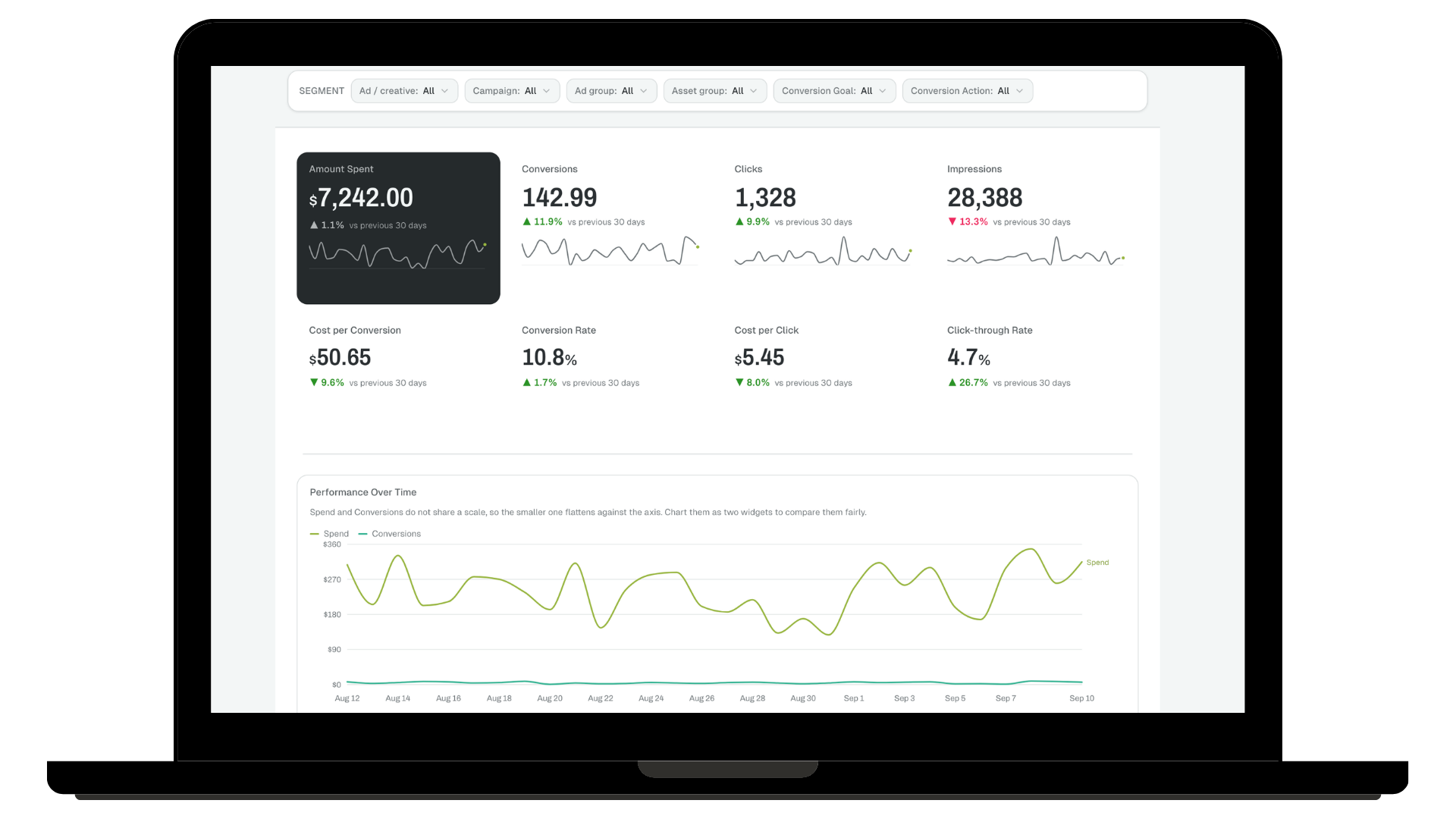
This is also what the Site Hub Reports dashboard is built to make visible every day, not just in a one-time audit. It pulls Google, Meta, GA4, call tracking and your CRM into a single live view, with platform-reported conversions sitting next to CRM-verified ones so you can see the gap the moment it opens, plus a monthly signal memo written in plain English for the owner, not the analyst.
What We Build
- GA4 Audit, Cleanup and Event Configuration
- Server-Side Tagging, Including Conversions API and Enhanced Conversions
- Call Tracking Wired to Source, Campaign and Keyword
- CRM-to-Ad-Platform Conversion Sync With Real Deal Values
- Site Hub Reports Dashboard, Live Across Every Channel You Run
What Changes For You
- One Trustworthy Number for Cost Per Closed Customer, Not Five Conflicting Ones
- Budget Decisions Made Against CRM-Verified Numbers, Not Platform Self-Reporting
- A Monthly Signal Memo Instead of a Raw Export Nobody Reads
- The Confidence to Scale Spend Without Wondering if the Tracking Is Lying to You
- A Measurement System You Own Outright, Built in Your Accounts, Not Ours
PRICING
Measurement Infrastructure Build, CRM-Integrated-
Core Build: $7,500, 30 Days, for Single-Platform Accounts
-
CRM-Integrated Build: $12,500, 45 Days, Most Chosen, Full CRM-to-Ad-Platform Sync
-
Multi-Brand Build: $18,000, 60 Days, for Multi-Location or Multi-Brand Accounts
-
GA4 Cleanup, Server-Side Tagging, Call Tracking and Real Conversion Values Included
-
Site Hub Reports Seat Included, Standalone Price Is $39 per Client per Month
-
One-Time Project, Required Before We Manage Any Paid Media Spend
Build Tier
Find Out What Your Numbers Are Actually Hiding
Tell us what you are tracking today, Google Ads, Meta, GA4, a CRM, or honestly not much. We will tell you on the first call whether you need a full build, a lighter fix, or whether your tracking already holds up.
Accolades & Partners






Frequently Asked Questions
What is marketing measurement, in plain terms?
It is making sure every system that touches a lead, your ad platforms, GA4, call tracking and your CRM, agrees on what actually happened. Done right, a closed deal traces back to the campaign that started it. Done wrong, each platform reports its own version of success and none of them are checked against your real revenue.
Why don't my Google Ads conversions match my CRM?
Usually because the platform is counting something different than a closed sale, a form submit before qualification, a duplicate fire, a call that never got attributed back to the campaign. An attribution audit traces the gap channel by channel. If Google reports 400 and your CRM shows 240 closed deals tied to those campaigns, that gap is exactly what we find and fix.
What is the difference between a Measurement Build and conversion rate optimization?
A Measurement Build makes sure your tracking reports the truth. Conversion rate optimization assumes your tracking already works and tests changes to your pages and funnels to convert more of the traffic you get. If your numbers cannot be trusted yet, that comes first. Details on testing and experiments are on our conversion rate optimization page.
How is this different from paid media management?
Paid media is the buying and optimizing of ad spend across search, social, display and more. We will not manage that spend against tracking we cannot trust, which is why a Measurement Build or a passed audit comes before any media retainer starts. Channel strategy and management pricing are on our paid media page.
How is this different from lead generation?
Lead generation builds the offers, pages, forms and follow-up that turn a visitor into a contact your sales team can work. Measurement is what proves whether that system, and everything feeding it, is actually producing revenue. Most businesses need both. Ours are priced and run separately, and lead gen details are on our lead generation page.
Do I need a Measurement Build if I am not running paid ads yet?
Yes, if you plan to spend on ads soon, and often yes even if you never do. GA4 accuracy, call tracking and CRM attribution matter for organic and referral traffic too. The build is priced the same regardless of whether media is running yet, since the plumbing work does not change.
Which build tier do most businesses choose?
CRM-Integrated, at $12,500 over 45 days, is the most common starting point, because most businesses running any real ad spend need their ad platforms talking to their CRM, not just to GA4. Core at $7,500 fits simpler, single-platform setups. Multi-Brand at $18,000 fits accounts managing more than one brand or location.
What is Site Hub Reports, and is it included?
It is our live dashboard pulling Google, Meta, GA4, call tracking and your CRM into one view, with platform-reported and CRM-verified conversions shown side by side, plus a monthly signal memo. It is included free with any Measurement Build and with every managed retainer at $2,000 a month and up. On its own, it runs $39 per client per month.
Do we have to start with the Growth Signal Audit before the build?
No, but most people do. The audit is a $4,500, two-week diagnostic that tells you exactly where your tracking is broken before you commit to a build tier. If your tracking already holds up, the audit will tell you that too, and you skip the build entirely. Half the audit fee credits toward any build signed within 60 days.
Do you guarantee our numbers will be perfect after the build?
No. We do not guarantee outcomes we cannot fully control, and anyone promising a perfect, permanent fix is overselling. What we commit to is a build that closes the specific gaps the audit finds, a dashboard that keeps the gap visible going forward, and a monthly signal memo that flags drift before it costs you a quarter of bad decisions.
Blogs & Resources




Reviews & Testimonials
Posted on Google
 Marmota Conejo
Trustindex verifies that the original source of the review is Google.
I had a great experience with the web designer. They were creative, professional, and attentive to my needs. The final website exceeded my expectations and was delivered on time. I highly recommend their services for anyone looking to enhance their online presence!Posted on Google Brittany QuataertThey do amazing work and very easy to work with! Highly recommendPosted on Google
 Bruno VeazI had a great experience with a web designer who created a beautiful and user-friendly website for my business. They understood my vision perfectly and delivered on time. Highly recommend their services!Posted on Google
 Chris BentleyI would highly recommend using SiteHub. They are absolutely amazing and literal masters of their craft!!Posted on Google
 JesúsI had a fantastic experience working with the team for my web design and digital advertising needs. Sean provided exceptional insights that helped shape my website, while Rylie’s expertise in SEO significantly boosted my online visibility. Nicole was always there to address my questions and ensure everything ran smoothly.Posted on Google
 Everything FamilySean and his team are great ! We’ve been using his company for a couple of years now and could not be happier with their services!Posted on Google
 WRUINA XIROMI ROSALES CUEVASThe web designer provided exceptional service! My website looks amazing, and he was very attentive to my needs✅👏🏻Posted on Google
 Alexa SalmherHuge thanks to Rylie and the team! Our new site looks amazing and we’ve already seen a noticeable increase in traffic and leads. They really know their stuff when it comes to digital marketing.Posted on Google
 TamiaWorking with Sean and Nicole has been a game-changer for our business. They redesigned our website, boosted our SEO rankings, and helped us launch ads that actually convert. Super professional and easy to work with. Highly recommend!
LET'S TALK
Stop Budgeting Off a Number Nobody Checked
A Growth Signal Audit is $4,500, fixed, two weeks ($6,500 for multi-location or multi-brand), and half of it credits toward any build you sign within 60 days.